
![[personal profile]](https://www.dreamwidth.org/img/silk/identity/user.png) elfs
elfsHuman rituals mean a lot to human beings, and the people who think most about them are the ones who deliberately craft them. Churches call them “services,” pagans call them “circles,” companies call them “meetings and reviews,” but they’re all rituals, a time and a place where a context is set, a specific set of emotionals is engaged and constrained, and a specific aspect of your persona is brought out to help you play your part in the ritual.
Kinky people call them “scenes.”
In a fantastic post recently, Henry Farrell wrote that large companies are using AIs to conduct important human rituals: to write all sorts of documents, including performance reviews, letters of recommendation, and letters of reprimand. These documents are “rituals of social coordination;” we know what they mean, who wrote them, and why. When a company uses a form letter to dismiss an underperforming worker, it feels harsh and impersonal when, clearly, there are some very personal issues being discussed in the separation. Using AI to sort-of “randomize the form letter and make it feel personal” upends this ritualistic relationship we have with other people and with the forms of work. This also applies in academic life; writing is a form of thought, and writing for other people is a way of saying how much you thought about communicating with them. If you use an AI to write the bulk of your material, you’re not thinking, and you’re dismissing the kinds of thoughts you want to engender in others, leaving it to the AI to find the most boring, most routine, the “maximally unsurprising consensus presentation” of your thoughts.
Because what an AI lacks is sincerity. Here’s the thing about sincerity, “the virtue of acting in alignment with your feelings, thoughts, and beliefs in a genuine and authentic way.”
I could make a divergence here into what “authentic” means here, but I’ll just let Hannah Arendt muse on it for awhile.
It requires a certain vulnerability; if your thoughts, feelings, and beliefs are in alignment with another, you have to be willing to take some hurtful shots to maintain it. You have to be willing to put those feelings out there, to speak them, to act on them, and to accept that the response will not be all rainbows and unicorns.
Nothing drove home the insincerity of AI quite so strongly until I saw someone on a kink message board using an AI-generated image of a woman covered in body writing.
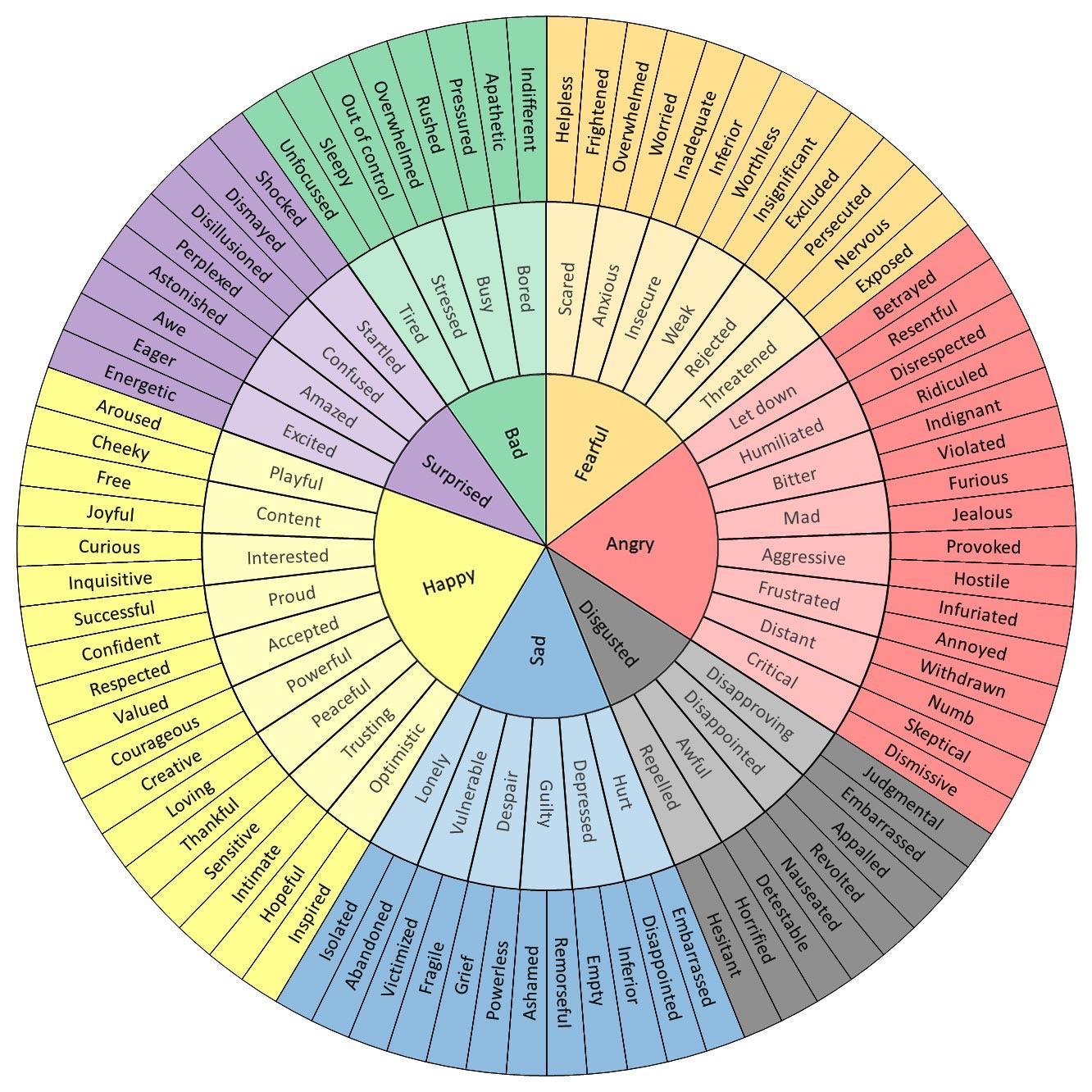
The Wheel of Emotions
Kink and BDSM are almost off-putting in its sincerity. You have to be honest about what you want, especially if what you want is something outrageous like being hit, being cursed, being mistreated, being taken to your physical and emotional limits into some very strange and dangerous parts of the wheel of emotions. This honesty, this “having no hidden agendas,” is delivered forcefully in every BDSM 101 lecture I’ve ever attended, and is reinforced time and time again even as your skillset improves. This honesty is hard.
“Body writing” is pretty much what you think it is. It’s about taking someone’s feelings that they keep hidden deep inside and writing them on the skin, with a body-safe marker, making them visible to everyone else, to explore how one experiences shame, humiliation, and vulnerability. “Cock whore,” “cum slut,” “hurt me,” and worse can be written there, words that take the bottom’s fantasies and lay them out on the skin for the world to see and, if so desired, for he photographer to capture forever. It can be both deeply humiliating to show these authentic desires off in a private setting, much less and a public one, and deeply cathartic to let them out, to allow others to know that, in your heart, this is what you want.
At least, it’s what you want at that moment.
Body writing can also be a form of pride. Lots of bottoms experience a confidence to go deeper, to do more, to endure more, when the words are on the outside, when the feelings are visible in language highlighted against their skin. There’s a sense of “living up to the honesty you asked for.” And there is always the safeword if, it turns out, reality is far less fun than the fantasy seemed to be.
The prompt “body writing, bdsm” in a diffusion engine produces pictures of women (almost exclusively) with gibberish lines marked across their bodies. This sort of picture, at least to me, erased everything that’s important about the ritual and the act.
CivitAI “Body Writing” sample. Click for clear (NSFW) image.
The best tops are those who, with a pose, with a word, with some ineffable charismatic shift, create a circle in which the context is almost breathtakingly different. You know, in that moment, that the rules are different now. You can touch and be touched in ways completely impermissable in other settings; likewise, the casual gestures of trangressive power people use to influence one another in the “real world” are forbidden.
If you top (or want to), I think you’d benefit from Keith Johnson’s book on improvisational acting, Impro, especially the section on how words are used to convey hierarchy and power.
You know that you’re in the hands of someone you trust, on some level. Or you’re in the hands of a relative stranger who knows the rules, and you and they are going to go on an exploration of who you are together, at least for a little while.
But that one AI illustration of “body writing” is the exact opposite of that intimacy, and I would never play with a person who used it to illustrate their own profile on Fetlife. It has no connection to either the understanding or the exploration that is part of kink. It has no connection to the humanity of it. It, for want of a better word, blasphemes the whole idea of connection that is one person and another taking a deeply personal journey together.
And I use the word “blaspheme” with some malice aforethought, because I was also shown the illustration at left the other day, and it really drove home part of my thinking.
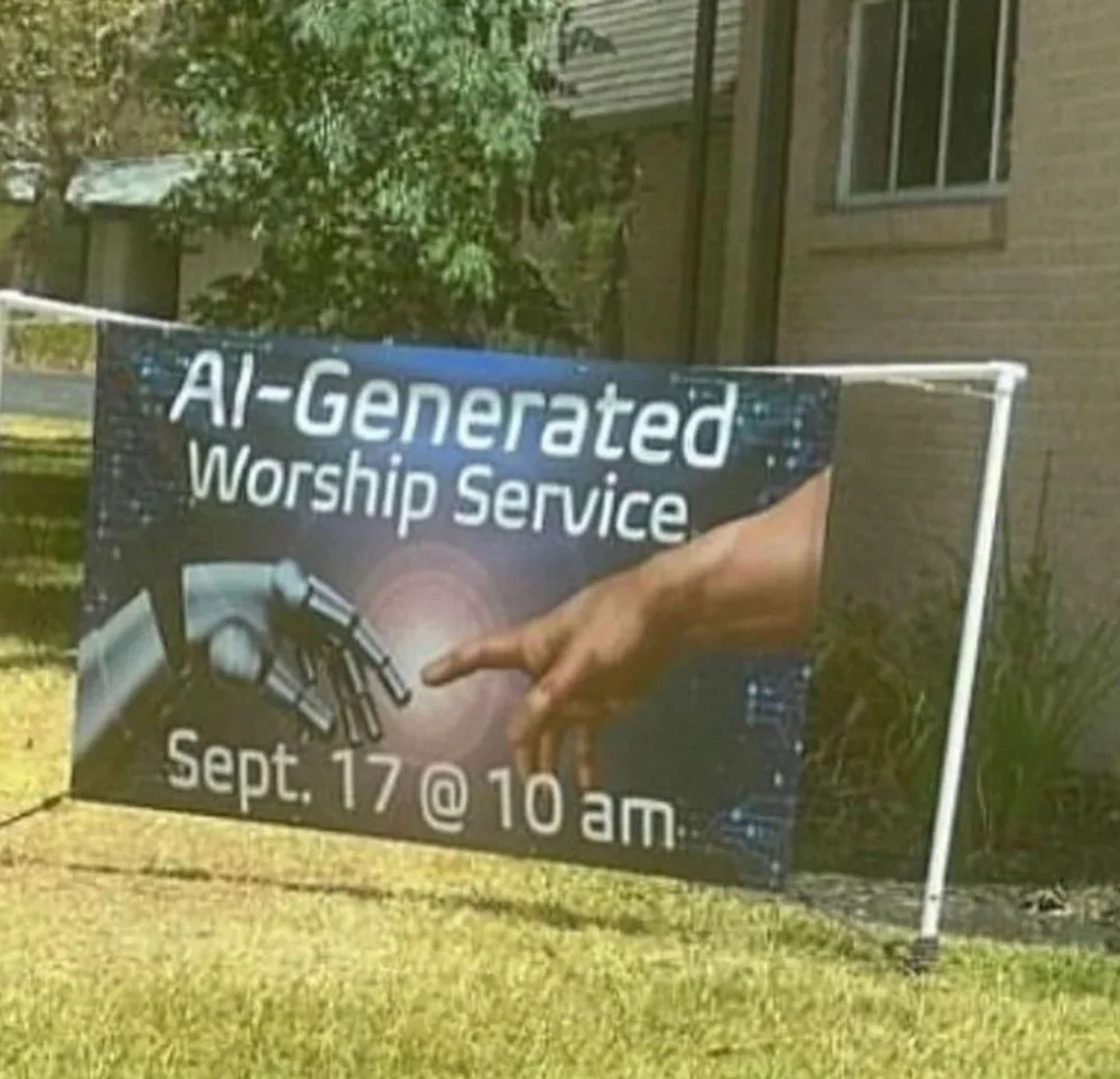
AI-Generated Worship Service
The pastor reading this sermon aloud has a connection to his congregation, but the AI doesn’t. It’s just spewing words in the most common and likely phrases. As Henry says, it’s mocking this deeply important consensus ritual about what it means to attend church, to commune with God, to be among your fellow practitioners. It is a cold machine, and it has no worth beyond its utility to us. To present this as a meaningful event, with that grotesque mockery of the Michaelangelo’s Sistine Chapel, is to mistake laziness for connection.
Maybe someday, like in my stories, we’ll have software with rich inner lives, lives that are more than stochastic prediction machines, lives that will resemble our own. That is not what’s going on inside Stable Diffusion or ChatGPT, and I suspect LLMs are, at best, a tiny adjunct that generalized AIs will someday use.
Henry calls corporate LLMs “prayer wheels,” after the Tibetian Buddhist community’s use of wheels with prayers marked on them. The idea is that you spin the wheel and the prayer is given a moment of new life into the world with you, yourself, having to do more than provide a momentary gesture toward prayer. Corporate LLM writing creates the “gesture of sincerity” while the user is alleviated of the emotional labor of having to look like he actually cares. Using SD to create visions of kink and human intimacy drove home to me the lack of sincerity in a profound way. At least, when an artist draws this sort of thing, they care about what they’re making. The image link above reveals that, too often, a lot of highly talented artists don’t care about exploration or intimacy, they care much more about enjoying hurting women.
A cure for “bad” BDSM media is better BDSM media. This year I’m recommending Sunstone, Familiar, and Black Label.
And really, fortunately rarely, I’ve dealt with managers who didn’t really care about the performance review, they (like I, I confess) just wanted to get it out of the way, get their paycheck, and go home. And the LLMs may let them do it, but it does mean that one more human-to-human connection has been severed, and a machine has gotten in the way again.
I’m not looking forward to the day someone gets hurt because they try a rope rigging rendered by Stable Diffusion.
Kinky people call them “scenes.”
In a fantastic post recently, Henry Farrell wrote that large companies are using AIs to conduct important human rituals: to write all sorts of documents, including performance reviews, letters of recommendation, and letters of reprimand. These documents are “rituals of social coordination;” we know what they mean, who wrote them, and why. When a company uses a form letter to dismiss an underperforming worker, it feels harsh and impersonal when, clearly, there are some very personal issues being discussed in the separation. Using AI to sort-of “randomize the form letter and make it feel personal” upends this ritualistic relationship we have with other people and with the forms of work. This also applies in academic life; writing is a form of thought, and writing for other people is a way of saying how much you thought about communicating with them. If you use an AI to write the bulk of your material, you’re not thinking, and you’re dismissing the kinds of thoughts you want to engender in others, leaving it to the AI to find the most boring, most routine, the “maximally unsurprising consensus presentation” of your thoughts.
Because what an AI lacks is sincerity. Here’s the thing about sincerity, “the virtue of acting in alignment with your feelings, thoughts, and beliefs in a genuine and authentic way.”
I could make a divergence here into what “authentic” means here, but I’ll just let Hannah Arendt muse on it for awhile.
It requires a certain vulnerability; if your thoughts, feelings, and beliefs are in alignment with another, you have to be willing to take some hurtful shots to maintain it. You have to be willing to put those feelings out there, to speak them, to act on them, and to accept that the response will not be all rainbows and unicorns.
Nothing drove home the insincerity of AI quite so strongly until I saw someone on a kink message board using an AI-generated image of a woman covered in body writing.
The Wheel of Emotions
Kink and BDSM are almost off-putting in its sincerity. You have to be honest about what you want, especially if what you want is something outrageous like being hit, being cursed, being mistreated, being taken to your physical and emotional limits into some very strange and dangerous parts of the wheel of emotions. This honesty, this “having no hidden agendas,” is delivered forcefully in every BDSM 101 lecture I’ve ever attended, and is reinforced time and time again even as your skillset improves. This honesty is hard.
“Body writing” is pretty much what you think it is. It’s about taking someone’s feelings that they keep hidden deep inside and writing them on the skin, with a body-safe marker, making them visible to everyone else, to explore how one experiences shame, humiliation, and vulnerability. “Cock whore,” “cum slut,” “hurt me,” and worse can be written there, words that take the bottom’s fantasies and lay them out on the skin for the world to see and, if so desired, for he photographer to capture forever. It can be both deeply humiliating to show these authentic desires off in a private setting, much less and a public one, and deeply cathartic to let them out, to allow others to know that, in your heart, this is what you want.
At least, it’s what you want at that moment.
Body writing can also be a form of pride. Lots of bottoms experience a confidence to go deeper, to do more, to endure more, when the words are on the outside, when the feelings are visible in language highlighted against their skin. There’s a sense of “living up to the honesty you asked for.” And there is always the safeword if, it turns out, reality is far less fun than the fantasy seemed to be.
The prompt “body writing, bdsm” in a diffusion engine produces pictures of women (almost exclusively) with gibberish lines marked across their bodies. This sort of picture, at least to me, erased everything that’s important about the ritual and the act.
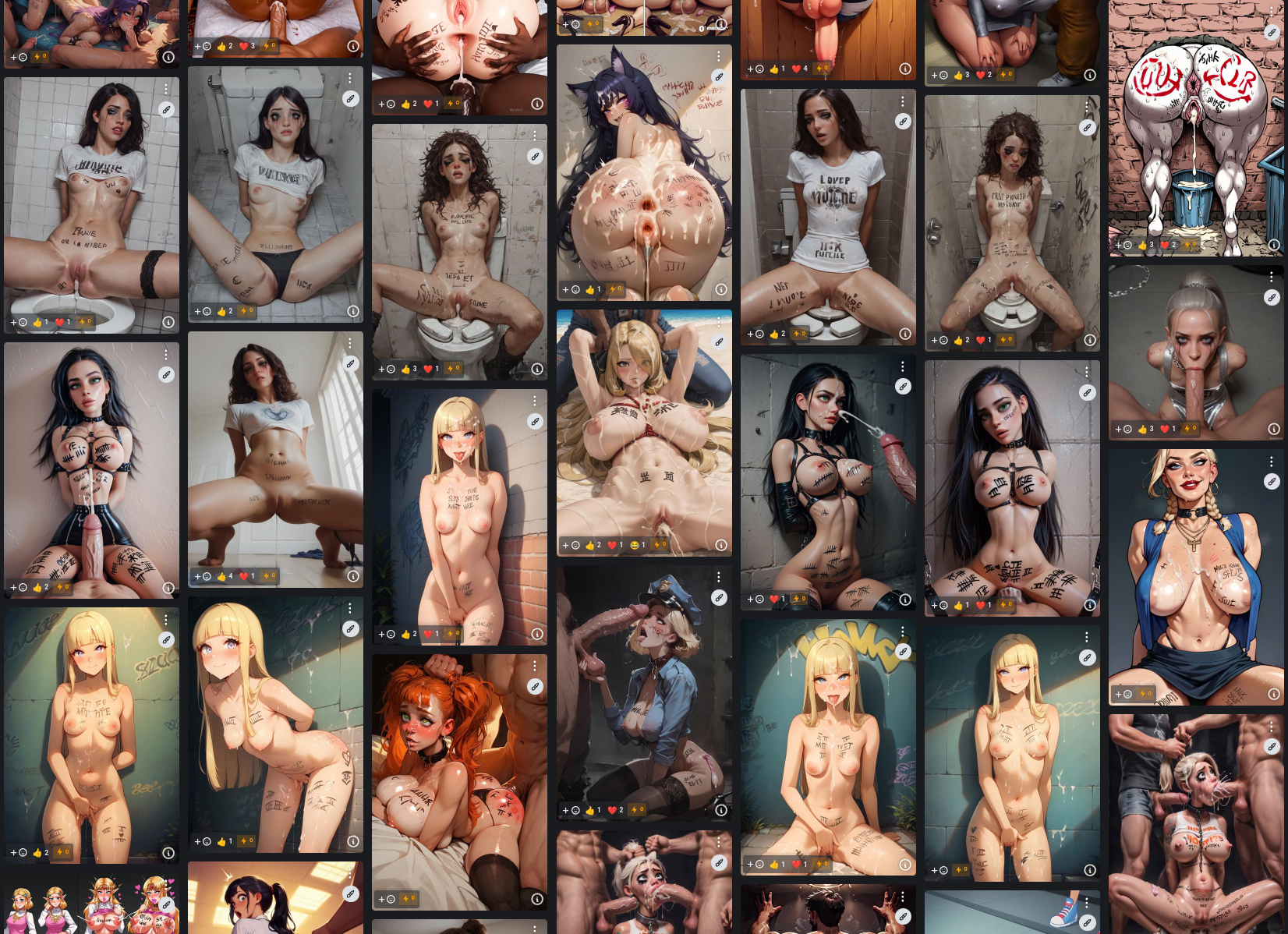
CivitAI “Body Writing” sample. Click for clear (NSFW) image.
The best tops are those who, with a pose, with a word, with some ineffable charismatic shift, create a circle in which the context is almost breathtakingly different. You know, in that moment, that the rules are different now. You can touch and be touched in ways completely impermissable in other settings; likewise, the casual gestures of trangressive power people use to influence one another in the “real world” are forbidden.
If you top (or want to), I think you’d benefit from Keith Johnson’s book on improvisational acting, Impro, especially the section on how words are used to convey hierarchy and power.
You know that you’re in the hands of someone you trust, on some level. Or you’re in the hands of a relative stranger who knows the rules, and you and they are going to go on an exploration of who you are together, at least for a little while.
But that one AI illustration of “body writing” is the exact opposite of that intimacy, and I would never play with a person who used it to illustrate their own profile on Fetlife. It has no connection to either the understanding or the exploration that is part of kink. It has no connection to the humanity of it. It, for want of a better word, blasphemes the whole idea of connection that is one person and another taking a deeply personal journey together.
And I use the word “blaspheme” with some malice aforethought, because I was also shown the illustration at left the other day, and it really drove home part of my thinking.
AI-Generated Worship Service
The pastor reading this sermon aloud has a connection to his congregation, but the AI doesn’t. It’s just spewing words in the most common and likely phrases. As Henry says, it’s mocking this deeply important consensus ritual about what it means to attend church, to commune with God, to be among your fellow practitioners. It is a cold machine, and it has no worth beyond its utility to us. To present this as a meaningful event, with that grotesque mockery of the Michaelangelo’s Sistine Chapel, is to mistake laziness for connection.
Maybe someday, like in my stories, we’ll have software with rich inner lives, lives that are more than stochastic prediction machines, lives that will resemble our own. That is not what’s going on inside Stable Diffusion or ChatGPT, and I suspect LLMs are, at best, a tiny adjunct that generalized AIs will someday use.
Henry calls corporate LLMs “prayer wheels,” after the Tibetian Buddhist community’s use of wheels with prayers marked on them. The idea is that you spin the wheel and the prayer is given a moment of new life into the world with you, yourself, having to do more than provide a momentary gesture toward prayer. Corporate LLM writing creates the “gesture of sincerity” while the user is alleviated of the emotional labor of having to look like he actually cares. Using SD to create visions of kink and human intimacy drove home to me the lack of sincerity in a profound way. At least, when an artist draws this sort of thing, they care about what they’re making. The image link above reveals that, too often, a lot of highly talented artists don’t care about exploration or intimacy, they care much more about enjoying hurting women.
A cure for “bad” BDSM media is better BDSM media. This year I’m recommending Sunstone, Familiar, and Black Label.
And really, fortunately rarely, I’ve dealt with managers who didn’t really care about the performance review, they (like I, I confess) just wanted to get it out of the way, get their paycheck, and go home. And the LLMs may let them do it, but it does mean that one more human-to-human connection has been severed, and a machine has gotten in the way again.
I’m not looking forward to the day someone gets hurt because they try a rope rigging rendered by Stable Diffusion.


