![[personal profile]](https://www.dreamwidth.org/img/silk/identity/user.png) elfs
elfsThe "intellectual dark web" has been all over a recent report that shows that in more egalitarian countries, women are less likely to join STEM projects. I'll be the first to say that I'm not at all surprised. This follows on another study that shows that the less social support your country has, the more likely men and women will pursue the same strategies.
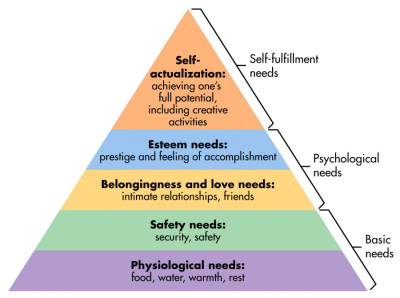
To understand this dilemma, you don't need to look very far— Maslow's heirarchy is a fine place to start. Now, to be fair, I find Maslow useful the way Kubler-Ross or Montessori is useful: as a general guideline that some people fall into easily, and many people can be convinced is "real" sufficient to manage their situation, but isn't some kind of universal truth applicable to everyone.
The basic premise is, as one headline puts it, "The more fair a country is, the bigger the gender gap in some professions." Or, put another way: the more likely men and women feel reassured that their needs toward the bottom of Maslow's pyramid are to be met, the more likely they'll feel comfortable pursuing personal goals.
I don't believe in Blank Slate, and very few people do. There are sex differences. These difference aren't binary, and human beings reside all over the map between the two poles of "masculine" and "feminine," but the vast majority do tend to cluster around one or the other. Freed of the basic needs of warmth, shelter, safety, and security, those people, the majority, will gravitate toward professions and activities that reflect their gender identity.
Where I depart, radically and affirmatively, from any of that gender-essentialism on the part of people like Peterson and Sullivan and their ilk is the notion that, because women are less likely to pursue STEM-related activities when their very success as human beings doesn't depend on their doing so, it therefore behooves us to spend no resources at all on attracting or keeping women in STEM. That because fewer (not "few," just "fewer") women would be involved in STEM if our society were fair does not mean that it's okay for STEM fields to be boys' clubs of misogyny and exclusion. There are a lot of women who still want to participate, and who deserve their place. After all, on a level surface women routinely write higher quality software than dudes. The office is no place for macho posturing and bullshit performative masculinity, not in the 21st century.
What intrigues me more, though, is the disconnect between this result, which the far right adores, and the desire of the far right for women to be more "feminine." Because note what the is really required: that the society become more fair. And the last thing the right wing wants is a "fair" society: a society with much less inequality, with more support for the poor and downtrodden, with higher taxes, a stronger safety net, and much less bias in law enforcement.
The right wing can "love" this outcome all they want, because it weakly "verifies" their gender-essentialist ideas; but they can never implement it because doing so strongly contradicts their Spencerian notions of how a society should work.
To understand this dilemma, you don't need to look very far— Maslow's heirarchy is a fine place to start. Now, to be fair, I find Maslow useful the way Kubler-Ross or Montessori is useful: as a general guideline that some people fall into easily, and many people can be convinced is "real" sufficient to manage their situation, but isn't some kind of universal truth applicable to everyone.
The basic premise is, as one headline puts it, "The more fair a country is, the bigger the gender gap in some professions." Or, put another way: the more likely men and women feel reassured that their needs toward the bottom of Maslow's pyramid are to be met, the more likely they'll feel comfortable pursuing personal goals.
I don't believe in Blank Slate, and very few people do. There are sex differences. These difference aren't binary, and human beings reside all over the map between the two poles of "masculine" and "feminine," but the vast majority do tend to cluster around one or the other. Freed of the basic needs of warmth, shelter, safety, and security, those people, the majority, will gravitate toward professions and activities that reflect their gender identity.
Where I depart, radically and affirmatively, from any of that gender-essentialism on the part of people like Peterson and Sullivan and their ilk is the notion that, because women are less likely to pursue STEM-related activities when their very success as human beings doesn't depend on their doing so, it therefore behooves us to spend no resources at all on attracting or keeping women in STEM. That because fewer (not "few," just "fewer") women would be involved in STEM if our society were fair does not mean that it's okay for STEM fields to be boys' clubs of misogyny and exclusion. There are a lot of women who still want to participate, and who deserve their place. After all, on a level surface women routinely write higher quality software than dudes. The office is no place for macho posturing and bullshit performative masculinity, not in the 21st century.
What intrigues me more, though, is the disconnect between this result, which the far right adores, and the desire of the far right for women to be more "feminine." Because note what the is really required: that the society become more fair. And the last thing the right wing wants is a "fair" society: a society with much less inequality, with more support for the poor and downtrodden, with higher taxes, a stronger safety net, and much less bias in law enforcement.
The right wing can "love" this outcome all they want, because it weakly "verifies" their gender-essentialist ideas; but they can never implement it because doing so strongly contradicts their Spencerian notions of how a society should work.


