Oct. 17th, 2011

elfs: (Default)
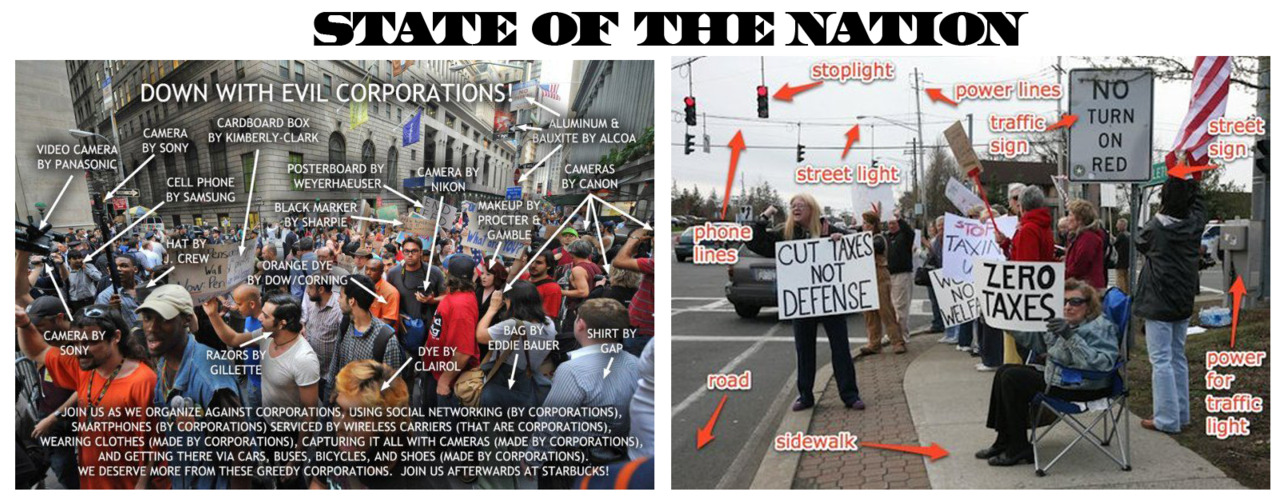
Andrew Sullivan points us to this photograph, and claims "Sometimes, the contradictions overwhelm."

I've seen that photo before, and yet I have to wonder, where is the contradiction?

With the exception of the few flakes FOX News gleefully hunts down with the tenacity of a truffle hound, most of the protestors in Occupy Wall Street have no problem with Panasonic, Sony, Weyerhauser, Canon, Starbucks, Gap, Eddie Bauer, or Clairol. Because those companies use labor to make stuff. They employ people. They create jobs.

The tea party and libertarian ideal is that wealth is generated by excellent service provided and exquisite products delivered. Occupy Wall Street is on the same page. What most of America is outraged about was in that Venn diagram Sullivan linked to several days earlier: the regulatory capture of our government by Wall Street, and the capture by campaign donations of our elected officials, who then look the other way. OWS is opposed not to capitalism or corporations, but to "corporatism." OWS is opposed to the way the regulatory mechanisms have become so corrupted that America no longer favor those who use labor to make stuff, but to those who, as Warren Buffet put it, "use money to make money."

The commentary is not equivalent. People protesting taxation on taxpayer-paid-for property would be an amusing contradiction if it wasn't woeful ignorance on display. People wearing and using manufactured products to protest institutions that make money while making manufacturing jobs disappear is neither ignorant or contradictory.
elfs: (Default)
Corey Robin's new book, The Reactionary Mind, has created a stir, and over at the left-leaning Dissent magazine Sheri Berman dissents from the book's message. Robin insists the books is a serious effort to understand the right and examine its leading ideas; Berman asserts that the book is one-sided and full of polemical attacks. Toward the end, Berman writes:
if one instead accepts that the rage, disenfranchisement, and disillusionment [of the right] are real, then the question becomes: why in the late twentieth and early twenty-first century has it found its home so often on the right rather than the left? This is a question that The Reactionary Mind leads directly to; it is not one that Robin—or the Left more generally—can or should avoid.
There's a problem with Berman's formulation, and it's the word missing from her list of... well, two are emotions, and one is a consequence of the action of others.

The missing word is "humiliation."

For the past forty years, the right has done everything it was told to do by its leadership. It voted, it prayed, it gave money, it got active when it was necessary. Yet modernity arrived nonetheless. Gays are getting married. Women occupy high office. The country is getting browner. There's a black man in the White House. Liberal states continue to get wealthier; conservative states continue to falter. Liberal states not only adhere to their own moral values more successfully than conservative states, they adhere to conservative moral values more successfully than conservative states.

All of this humiliates the right. They know they're in an unwinnable war with, if not The End of History, at the very least the end of the racially and religiously homogenous little worlds they lived in when they were young. With the coming of the Internet, they've been shown just how full the world is of people unlike them. It's worse then they thought.

The mission of the left should be (indeed, must be) to convince the right that continuing to identify with those who tilt our legislators and executives toward favoring those who "make money with money" rather than those who "create wealth by making good things and providing good services" is not in their best interests.

Instead, sites like Daily Kos continue to put forward the idea that conservatives deserve to be humiliated, and that the only successful way forward is to not reason with them, not bargain with them, to not feel pity, or pain, or remorse, or fear, but to just roll over the conservatives.

And this is why I have such deep cynicism right now about the whole process. Neither side has any genuine humility, no genuine interest in looking at the premises under which they labor. "The 99%" (and this includes most of the so-called "53%") believe in the dignity and creative power of labor. But deep within the two poles of James Sinclair's Venn Diagram are a pair of magnets, each labeled "a sense of security," but with different illustrations, that draws people out from the center, and makes them forget what they're really protesting.
elfs: (Default)
Homeopathic economist suggests injecting 'up to $1' into economy:
Harliton has calculated that $1 invested properly will completely cure the world economy. "The key is to find the correct dilution."
elfs: (Default)
The "experimental ecology" website has an interesting article called "Why do hockey players support helmet rules, even though they choose not to wear helmets when there is no rule?"

The answer, it seems, is that everyone perceives the helmet as a handicap. They would all like to play a game in which it is more likely that they all come out in one piece and without traumatic brain injury, but they're unwilling to do so if only they are handicapped, and the other fellow not. Therefore, they accept the rules, and even vote to empower an authority (the National Hockey League, in this case) to enforce the rules uniformly.

It seems to me that this is a perfect place where sport shows up the libertarian versus command economy dichotomy: we would all like to live in a state where we're more likely to make it to old age than not, but only by voting to empower an authority to enforce the rules necessary to make that happen do we get something approaching justice. That's the purpose of government.

(You kinda have to admire the desperate libertarian argument that, because excellent players are a statistically small portion of all players, " the secret preference of a majority of hockey players for a helmet requirement is simply signalling that most mediocre hockey players are hoping to handicap everyone, on the chance that the better ones will suffer most." That proposal is empircally testable: was there a drop in performance after the adoption of helmet rules, and did degrade the best players' performance proportionately? If not, this is a ridiculous handwave.)

Profile

elfs: (Default)
Elf Sternberg

December 2025

S M T W T F S
 12345 6
78910111213
14151617181920
21222324252627
28293031   

Most Popular Tags

Style Credit

Expand Cut Tags

No cut tags
Page generated Jan. 5th, 2026 01:24 pm
Powered by Dreamwidth Studios